The construction industry has changed dramatically over the past decade. Drawings alone are no longer enough to manage complex buildings, tight schedules, and strict budgets. This is where Building Information Modeling, or BIM, comes in. BIM has become an essential part of how modern projects are planned, designed, and built—especially in fast-paced markets like Dubai.
At Studio Navis, we regularly work with developers, contractors, and MEP consultants in Dubai who want better clarity, coordination, and control over their projects. One of the most common questions we hear is: What’s the real difference between 3D, 4D, and 5D BIM?
What BIM Really Means
BIM is not just a 3D model. It’s a shared digital process that brings together design, construction, and operational information in one place. A BIM model contains data about materials, dimensions, systems, timelines, and costs—helping everyone involved make better decisions from day one.
As BIM develops from 3D to 4D and 5D, it becomes more powerful and more useful.
3D BIM: Seeing the Project Clearly
3D BIM is where everything begins. It focuses on creating accurate, intelligent 3D models of a building’s architectural, structural, and MEP elements.
Instead of working with disconnected 2D drawings, teams can view the entire building in three dimensions. Walls, slabs, ducts, pipes, and cables are all modeled exactly as they will be built.
For MEP consultants in Dubai, 3D BIM is especially important. MEP systems are often the most complex part of a building, and 3D modeling helps identify clashes early—before they turn into costly site issues.
Why 3D BIM Matters
- Clear visualization of the design
- Better coordination between disciplines
- Early clash detection
- Fewer design errors and revisions
Simply put, 3D BIM helps everyone see the same picture and work from the same information.
4D BIM: Understanding Time and Sequence
Once the 3D model is ready, 4D BIM adds the next layer: time.
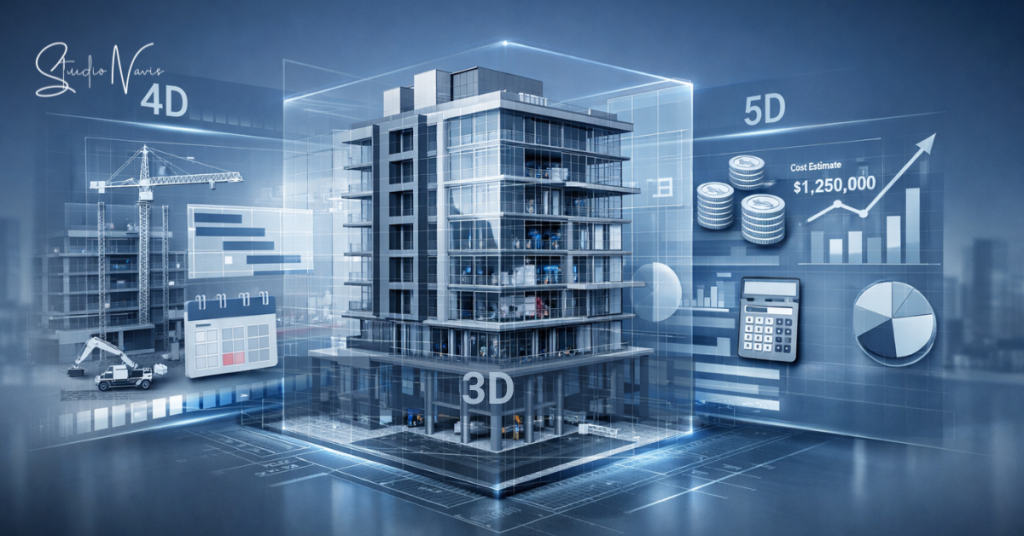
4D BIM links the construction schedule to the 3D model. This allows project teams to see how and when each part of the building will be constructed. Instead of reading complex Gantt charts, stakeholders can watch the project unfold virtually.
As experienced BIM consultants in Dubai, we’ve seen how powerful this can be for contractors and project managers. Construction sequencing becomes clearer, and potential delays can be spotted early.
Benefits of 4D BIM
- Better construction planning
- Clear understanding of project phases
- Improved coordination between trades
- Reduced delays and site conflicts
5D BIM: Bringing Cost Into the Model
5D BIM adds the final major dimension: cost.
With 5D BIM, every element in the model is connected to quantity and cost information. This means changes in design automatically reflect in updated quantities and cost estimates.
For developers and contractors, this level of insight is invaluable—especially in a market like Dubai, where budget control is critical.
At Studio Navis, we use 5D BIM to help teams make informed decisions, compare design options, and avoid unexpected cost overruns.
Why 5D BIM Is So Valuable
- Accurate quantity take-offs
- Real-time cost updates
- Better budget control
- Fewer financial surprises
5D BIM transforms cost management from a reactive process into a proactive one.
Why These BIM Levels Are Essential in Dubai
Dubai’s construction projects are often large, complex, and fast-tracked. Traditional methods struggle to keep up with this pace.
That’s why BIM consultants in Dubai and MEP consultants in Dubai increasingly rely on 3D, 4D, and 5D BIM to reduce risk, improve coordination, and deliver projects successfully.
BIM helps:
- Avoid clashes on site
- Improve collaboration between teams
- Keep projects on schedule
- Maintain tighter control over costs
How Studio Navis Can Help
At Studio Navis, we provide practical, results-driven BIM services that support projects from concept to construction. Our team works closely with architects, contractors, and consultants to ensure BIM models are accurate, coordinated, and aligned with real-world construction needs.
Our services include:
- 3D architectural, structural, and MEP BIM
- 4D construction sequencing and simulations
- 5D cost modeling and quantity take-offs
Final Thoughts
Understanding the difference between 3D, 4D, and 5D BIM is key to making better decisions in today’s construction environment. Each level adds more value, insight, and control, helping projects run smoother from start to finish.
If you’re looking for reliable BIM consultants in Dubai who understand both technology and construction realities, Studio Navis is ready to support your next project with smart, human-focused BIM solutions.
What is BIM in construction?
BIM (Building Information Modeling) is a digital process that combines 3D design, data, scheduling, and cost information to plan, design, and manage construction projects more efficiently.
What is the difference between 3D, 4D, and 5D BIM?
3D BIM focuses on visual modeling, 4D BIM adds construction scheduling, and 5D BIM integrates cost and quantity data for better budget control.
Why is BIM important for construction projects in Dubai?
Dubai projects are often complex and fast-tracked. BIM helps improve coordination, avoid clashes, control costs, and keep projects on schedule.
How does 3D BIM help MEP consultants?
3D BIM allows MEP systems to be modeled accurately, helping detect clashes early and reduce errors during construction.
What are the benefits of 4D BIM?
4D BIM improves construction planning by linking the project schedule to the 3D model, making sequencing clearer and reducing delays.
How does 5D BIM improve cost management?
5D BIM connects model elements with cost data, providing accurate quantity take-offs, real-time cost updates, and better budget control.
Who should use BIM services?
Developers, architects, contractors, and MEP consultants can all benefit from BIM services to improve collaboration and project efficiency.
Are BIM consultants required for large projects?
While not always mandatory, BIM consultants are highly recommended for large or complex projects to ensure coordination, accuracy, and risk reduction.